
DOOM: THE DARK AGES
AAA First-Person Shooter | The Third Entry in the Modern DOOM series
idSoftware | Technical Designer
Technical Designer, responsible for designing, prototyping, and iterating on visual-scripted gameplay features, including level logic, puzzle mechanics, enemy behaviors, and map transitions.
Led design efforts on boss fight experiences, working with a team of designers, animators, and programmers.
Worked in proprietary game engine (idTech 8) and helped develop visual scripting tools based on Unreal Engine Blueprints.
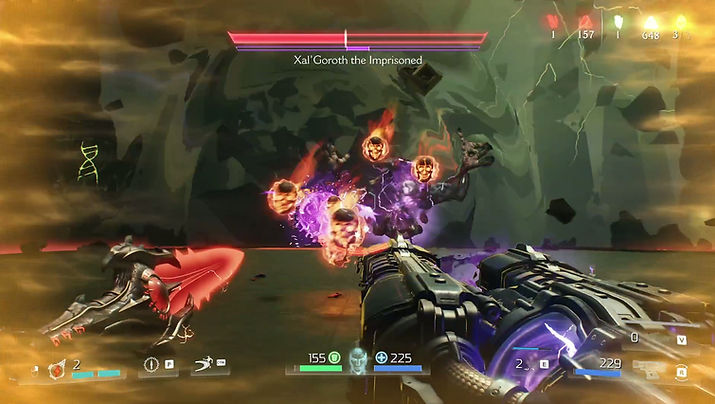
Xal'Goroth The Imprisoned - DLC Secret Final Boss
I was responsible for the design and implementation of all the boss's behaviors and the overall flow of the fight.
This included:
-
Collaborating with the game director and iterating on the purpose and desired play experience of each behavior.
-
Managing and tracking the spawning/despawning of entities, including projectiles, damage volumes, minor AI, movement splines, etc.
-
Tuning damage and stats parameters.
-
Creating and managing mechanics for the dynamic floor, including creating movement timelines and pattern arrangement graphs.
-
Linking gameplay actions to activate via animation events.
-
Tuning animation timings for iteration purposes.
Meteor Crash Attack

Meteor Crash Attack
The boss summons a meteor from the debris in the skybox to crash onto the arena, fully removing the floor for a short amount of time. The player must avoid the meteor collision and then navigate the loss of the floor, trying to land on the small safe-zone that rises first.
Energy Wall Attack (Phase 1)

Energy Wall Attack (Phase 3 Escalation)

Energy Wall Attack
The boss spawns moving energy walls down the aisle of the arena, each one stretching across a large portion of the play space. The final wall stretches across the entire arena but is short enough that the player can use the arena's grapple-hook node to leap over it.
The player must navigate quickly around the walls or take damage.
Escalation
In the second and third phases of the fight, this attack increases in difficulty by removing large portions of the floor. This escalation requires the player to make use of their airborne movement abilities to avoid taking damage.
Tentacle Attack (Phase 2)

Tentacle Attack (Phase 3 Escalation)
Tentacle Attack
The tentacle attack is introduced as the boss transitions into the second phase of the fight. Portals open at the front of the arena, launching cosmic tentacles out in a straight line towards the player's current position. Each tentacle knocks out a column of the floor, forcing the player to maneuver to safe sections of the arena until the attack ends.
Escalation
In the third phase of the fight, this attack changes so that tentacles continue attacking until the entire arena has fallen away, forcing the player to navigate a smaller and smaller space until the floor is completely gone. The player must then keep themself airborne using the grappling-hook for a short time until the floor resets.
Technical Design Process
Overview
Working in lock-step with the gameplay design team, I start with a design spec, create a functioning class, and hand it off to designers with the variables and levers they need to fine-tune the player experience.
"Hellfighter"
An enemy ship that patrols a set path for the player to hunt, pursue, and destroy. The Hellfighter adjusts its speed depending on the player's proximity, and drops rewards when destroyed.
"Dragon Landing Zone"
A gameplay class that manages animations, camera fades, level loading, and player control to seamlessly transition between gameplay modes

Planning and Organization
In the initial design discussion with the design team, I offer my expertise on what our engine is currently capable of, and how much of a lift a desired gameplay class would be to implement.
If there are gaps in engine capabilities, we also include engine programmers to determine if and how difficult it would be to fill said gaps.
With the initial design spec, I create and work with a logic flowchart to facilitate the creation of the gameplay class and its visual-scripted functionality. Some gameplay classes are time-based (i.e. first ‘x’ occurs, then ‘y’, then ‘z’) while others are event driven via triggers, switches, or various player inputs.
My priority as a technical designer is to identify and expose variables that gameplay designers can use to fine-tune and perfect the player experience. Some variables are requested up front (”We want to control how fast the elevator moves”), while others are implied or come up during the implementation process.
Acceleration/deceleration rates, the number and variety of spawned entities, delays and other timing specifications are just a few examples of potential variables kept in mind to expose to designers.
"Cosmic Rift"
An attack from "The Old One" boss fight.
The boss becomes temporarily invincible, summoning a "cosmic orb" that continuously pulls the player inward. After a countdown telegraphed by circular effects on the ground, the cosmic orb detonates, damaging and repelling the player if they are too close.

"Dimensional Merge"
An escalation attack from "The Old One" boss fight, marking the transition between boss phases. It involves a number of stars raining from the sky and opening portals from which tentacles emerge and attack upwards.

After a first working prototype is created and handed off to the gameplay designers, the process repeats iteration by iteration.
At any point, the design spec can be adjusted as new functionality or exposed variables are requested.
At each step there is communication and discussion between myself and the gameplay designers, producers, engine programmers, and art teams as needed.